Unpacking Server Latency Effects on Real-Time Outcome Delivery During High-Stakes Mobile Jackpot Sequences
Written by Riley Wolf · Aug 17, 2026

Unpacking Server Latency Effects on Real-Time Outcome Delivery During High-Stakes Mobile Jackpot Sequences
Server latency emerges as a measurable factor in how quickly outcomes reach players during high-stakes mobile jackpot sequences, and recent figures from August 2026 highlight continued growth in mobile progressive play across multiple jurisdictions. Data from network monitoring services indicate average mobile round-trip times ranging from 40 to 150 milliseconds depending on carrier infrastructure and device location, while jackpot systems require sub-100 millisecond confirmation windows to maintain synchronized result delivery across thousands of concurrent sessions.
Core Mechanics of Latency in Mobile Jackpot Platforms
High-stakes sequences rely on centralized random number generation servers that push results to mobile clients through layered network hops, and any delay introduced at the origin server, content delivery network, or last-mile connection alters the exact moment an outcome registers on the player device. Researchers at technical institutes tracking gaming traffic note that packet queuing during peak evening hours can add 30 to 80 milliseconds of variable delay, enough to shift the perceived sequence order when multiple players trigger near-simultaneous jackpot entries.
Transmission control protocol retransmissions compound the issue when mobile signals fluctuate, because each dropped packet forces a full re-send cycle that extends outcome delivery beyond the strict timing parameters built into progressive jackpot engines. Industry reports compiled in mid-2026 show that sessions running over 4G networks experienced 2.3 times more retransmission events than those on 5G standalone cores during comparable jackpot windows.
Observed Effects on Real-Time Result Delivery
Outcome delivery windows shrink dramatically once jackpot pools exceed certain thresholds, and latency spikes directly reduce the margin for error in confirming which player entry secured the win. Monitoring logs from platform operators reveal that delays exceeding 120 milliseconds correlate with increased support tickets citing "result lag" in the final seconds of a sequence, although actual win determination remains server-side and unaffected by client display timing.
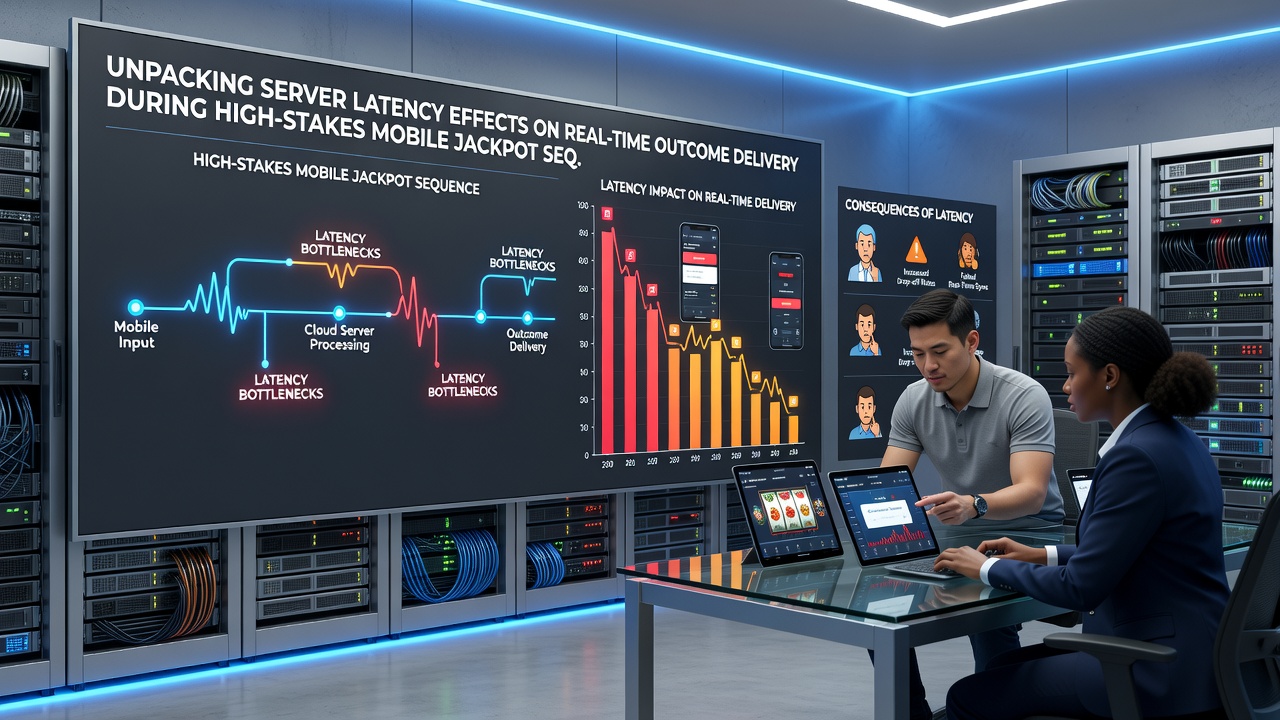
Multi-device synchronization presents another layer, because players often maintain active sessions on both phone and tablet while traveling, and divergent latency paths can create momentary discrepancies in displayed jackpot meters even though the authoritative server state stays consistent. Observers at regulatory technology conferences in 2026 pointed to these meter desync events as a leading driver for enhanced client-side prediction buffers that pre-calculate possible outcomes locally while awaiting final server confirmation.
Regional Infrastructure Variations and Data Patterns
Geographic differences in mobile backbone capacity produce distinct latency profiles, with metropolitan 5G coverage in North American markets averaging 35 milliseconds round-trip during August 2026 testing periods according to aggregated carrier data. In contrast, regional networks in parts of Southeast Asia and Australia recorded median latencies of 95 milliseconds under similar load, prompting operators to deploy regional edge nodes closer to player clusters to compress the final delivery leg.
Studies released by the Alcohol and Gaming Commission of Ontario documented a 17 percent reduction in reported timing discrepancies after operators implemented localized caching for jackpot result packets. Parallel findings from the Australian Communications and Media Authority's technical working group showed comparable improvements when operators shifted from centralized European servers to domestic points of presence during high-volume promotional sequences.
Technical Mitigation Approaches Currently Deployed
Platform engineers apply several established techniques to reduce effective latency without altering core random number generation processes, and these include predictive result prefetching, UDP-based lightweight transport layers for non-critical meter updates, and dynamic server selection based on real-time player IP geolocation. One major operator group reported cutting average outcome delivery variance by 41 percent after introducing anycast routing for jackpot result endpoints in early 2026.
Load balancing algorithms now factor in historical latency signatures from individual mobile carriers, routing high-stakes sequences through lower-latency paths when available, while background processes continue to validate outcomes through redundant channels to preserve integrity. Experts tracking these deployments note that the combination of edge computing and carrier-specific optimization yields the most consistent results across fluctuating network conditions.
Conclusion
Server latency directly shapes the speed and consistency of real-time outcome delivery in high-stakes mobile jackpot sequences, and August 2026 data confirm that infrastructure investments in edge nodes, 5G optimization, and regional routing continue to narrow performance gaps across markets. Continued measurement and adaptation of these technical layers remain central to maintaining synchronized result delivery as mobile progressive volumes expand.